Description
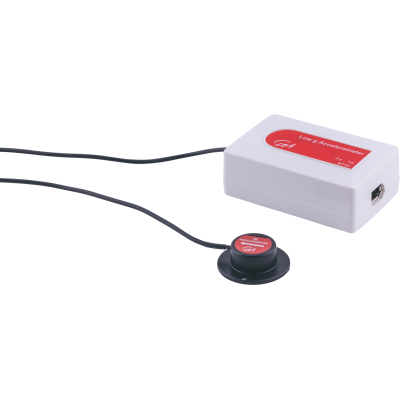
The range of accelerations measured by the Low g Accelerometer lay in the range which human body could experience without damage. Many collisions will produce much larger acceleration so this sensor should not be used for collisions experiments or for measuring accelerations above ± 4.8 g .
The Low g Accelerometer is delivered with two pieces of Velcro tape, which can be used to mount the round box of the Accelerometer on a moving object.
The Accelerometer should be mounted in the appropriate orientation for an experiment (so that its axis is in the direction of interest).
The Accelerometer can be used for a wide variety of experiments, both inside and outside the classroom:
- Measuring acceleration of a dynamics cart on a track
- Measuring the tilt of an object (for example a vertical balk placed on the table). Angles can be measured to the nearest degree
- Measuring acceleration as you swing the Accelerometer as a pendulum bob
- Measuring accelerations during body movements: put the Accelerometer under your belt buckle, and jump up and down, land both with your knees flexed and with your knees held more stiff
- If you have the CMA VinciLab data-logger you might measure acceleration on elevators, on amusement park rides, on playground apparatus, on remote-control toy cars, in a car, etc.
- To measure acceleration in two or three directions mount two or three Accelerometers at right directions.
DO NOT drop the sensor directly onto a solid surface this will damage the sensor.
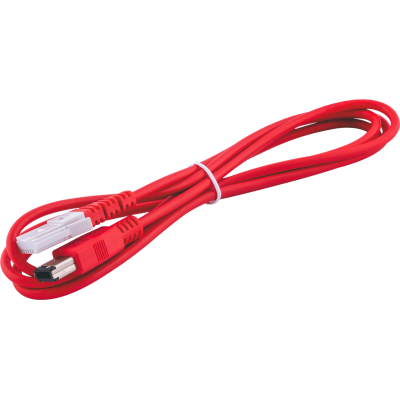
The Low g Accelerometer can be directly connected to analog BT inputs of the CMA interfaces. Attention: The sensor cable BT – IEEE1394 needed to connect the sensor to an interface is not supplied with the sensor and has to be purchased separately (BTsc_1 or BTsc_1Short).
Technical specifications of the sensor are descibed it the manual, see downloads.