Description
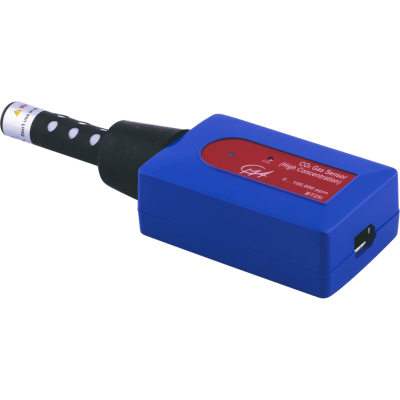
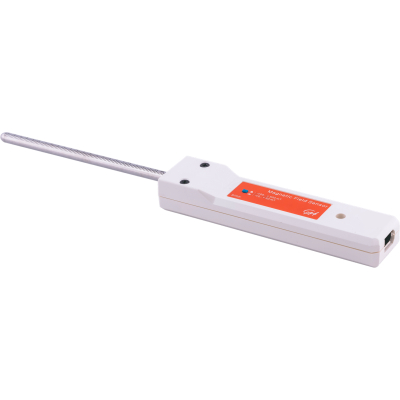
The CO2 sensor’s measuring principle is based on the absorption of infrared (IR) radiation. At the end of the sensor’s rod is a filament that emits IR radiation. Opposite this IR source is a detector that measures two wavelengths: the first in a narrow band around 4260 nm, the wavelength where CO2 absorbs the most IR, and a second wavelength where no CO2 absorption occurs. This second wavelength is used to compensate for temperature fluctuations and other external influences. This increases the sensor’s stability and accuracy.
As the CO2 concentration increases, the detector receives less IR radiation at 4260 nm. When the sensor measures, the intensity of the IR source is modulated, taking a measurement every 3 seconds.
Suggestions for experiments:
- Measuring the CO2 content of human exhaled air (approx. 50,000 ppm)
- Measuring the CO2 content (respiration) of animals and insects
- Monitoring CO2 production during chemical reactions, e.g., Na2CO3 + HCl –> CO2 + H2O + NaCl
- Monitoring CO2 production during sugar fermentation
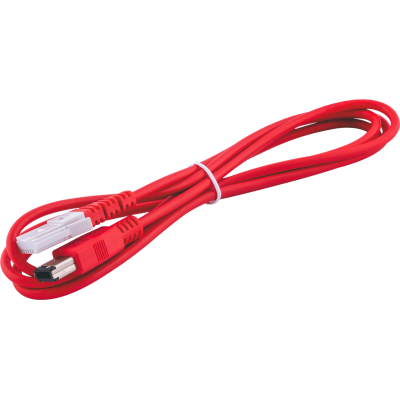
The CO2 gas sensor can be connected to the analog BT inputs of the CMA interfaces. Note: The BT – IEEE1394 sensor cable required to connect the sensor to these interfaces is not included with the sensor and can be ordered separately (CMA Item: BTsc_1).
Technical specifications of CO2 Gas Sensor are described in the CO2 Gas Sensor manual, see downloads.