Description
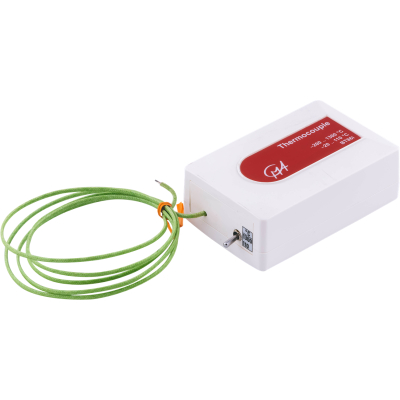
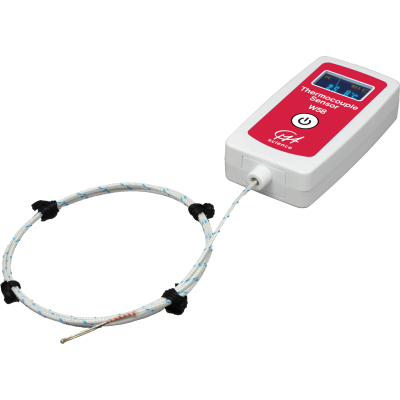
The sensor uses a thermocouple type K. The thermocouple consists of Chromega (Nickel – Chromium) and Alomega (Nickel – Aluminium) wires that are welded together at one end to form a measuring (hot) junction. The other ends of the wires form the so-called cold junction.
The thermocouple sensor can be used for temperature experiments in physics and chemistry. (the sensor is quick and precise).
Examples of applications for the wide temperature range (-200 .. 1300 °C):
- Measurements of the temperature inside a Bunsen burner flame or candles
- Experimentally determine the melting point of copper, bismuth, or other solids
Examples of applications for the narrow temperature range (-20 .. 110 °C):
- Measuring freezing and boiling points
- Specific heat experiments
- Measurement of vaporization heat (using a piece of tissue wrapped around the measuring joint, moistened with water or alcohol)
- Measurement of respiration
- Measurement of skin temperature
The Thermocouple can be directly connected to the analog BT inputs of the CMA interfaces.
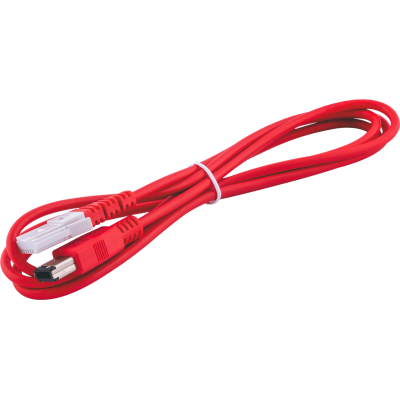
Attention: The sensor cable BT – IEEE1394 needed to connect the sensor to an interface is not supplied with the sensor and has to be purchased separately (CMA Art. Nr BTsc_1 or BTsc_1Short).
Technical specifications of the sensor are described in the product manual, see downloads.