Description
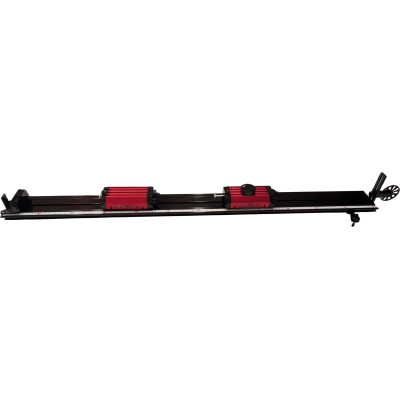
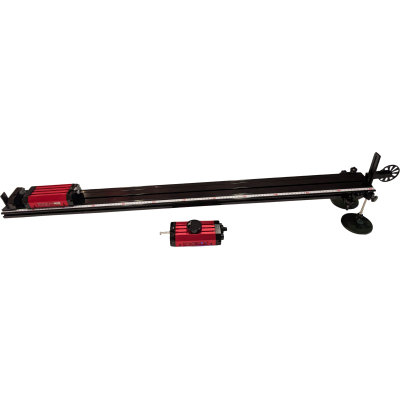
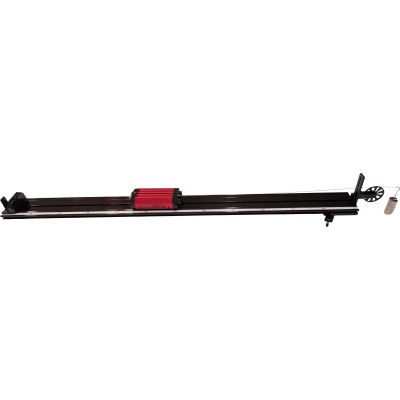
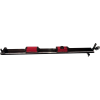
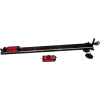
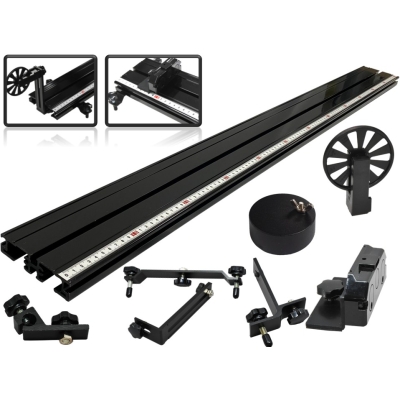
The Wireless Motion+ System consists of: 2 motion+ carts and the track and accessories set.
The cart sensors can be used wirelessly via Bluetooth with the Coach 7 or Coach 7 Lite programs/apps on computers (Windows and Mac), Chromebooks, and mobile devices (Android and iOS).
The Motion+ cart has four built-in sensors:
- Magnetic rotation encoder, which measures speed and position
- Force sensor, which measures the force on the Motion+ cart during collisions
- 3-axis accelerometer to measure acceleration
- 3-axis gyroscope to measure angular velocity
Technical specifications:
- Measurement ranges:
- Speed: -3 to 3 m/s
- Force: -100 to 100 N
- Acceleration (3 directions): -16 to 16 g
- Angular velocity (3 directions): -500 to 500°/s
- Warranty: 36 months
- Material: Anodized aluminum
- Weight: 500g
- Operating conditions: -20 to 60°C, max. 85% RH
- Maximum sampling rate: 100 Hz
- Battery life: 4 hours when fully charged (rechargeable)
- Connectivity: Bluetooth 5, Low Energy (Mac, Android, iOS) Bluetooth 2.1, Classic (Windows)
Full sensor specifications can be found in the Product Manual, see Downloads.
Suggested experiments with one Motion+ cart:
- Study motion by measuring position, velocity, and acceleration
- Measure acceleration on inclined planes to explore gravitational force and friction
- Newton’s Second Law: Investigate the relationship between force, mass, and acceleration
- Measure impulse and compare it to changes in momentum
- Hooke’s Law: Use a spring to measure displacement and find the spring constant
- Study static and kinetic friction on different surfaces
- Explore potential and kinetic energy by rolling the cart down an incline
- Perform experiments with spring plunger-triggered kinetic and potential energy transformations
- Study circular motion by attaching the cart to a rotating platform
Suggested additional experiments with two Motion+ carts:
- Newton’s Third Law: Study action and reaction forces in collisions
- Perform collision experiments to observe and calculate momentum conservation in elastic and inelastic collisions
- Study how kinetic energy is conserved or transformed in different types of collisions