Description
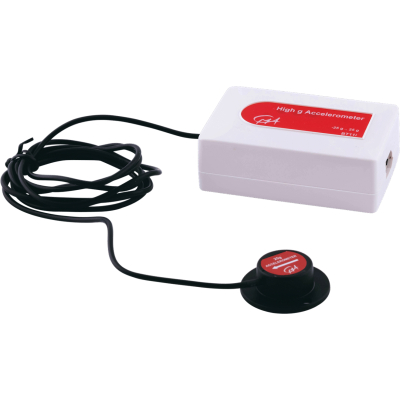
The measurement range of the High g Accelerometer allows measuring accelerations produced during collision experiments but dropping the Accelerometer on a hard surface from even a few centimeters can produce acceleration of a hundred g’s. Accelerations above ± 50 g will damage the sensor.
The High g Accelerometer is delivered with two pieces of Velcro tape, which can be used to mount the round box of the Accelerometer on a moving object.
The Accelerometer should be mounted in the appropriate orientation for an experiment (so that its axis is in the direction of interest).
The Accelerometer can be used for a wide variety of experiments, both inside and outside the classroom:
- Measuring acceleration during a collision
- Measuring acceleration as it moves in a horizontal circle and/or vertical circle
- Measuring accelerations during body movements: put the Accelerometer under your belt buckle, and jump up and down, land both with your knees flexed and with your knees held more stiff
- If you have the CMA VinciLab data-logger you might measure acceleration on elevators, on amusement park rides, on playground apparatus, in a car, during bungee jumps, etc.
- To measure acceleration in two or three directions mount two or three Accelerometers at right directions.
DO NOT drop the sensor directly onto a solid surface this will damage the sensor.
The High g Accelerometer can be directly connected to analog BT inputs of the CMA interfaces.
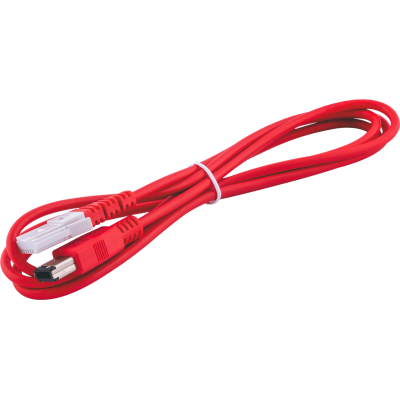
Attention: The sensor cable BT – IEEE1394 needed to connect the sensor to an interface is not supplied with the sensor and has to be purchased separately (BTsc_1 or BTsc_1Short).
Technical specifications of the sensor are described in the product manual, see downloads.