Description
The sensor can be used wirelessly via Bluetooth or wired via USB with the Coach 7 or Coach 7 lite programs/apps on computers (Windows and Mac), Chromebooks and mobile devices (Android and iOS).
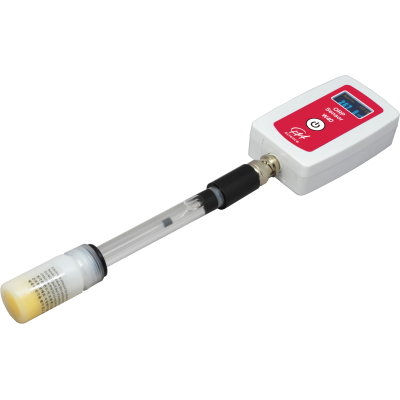
The ORP sensor consists of an amplifier and an ORP electrode attached to the amplifier through a BNC connector. The electrode is housed in a long plastic tube with an opening at the bottom and is supplied with a storage bottle containing a protective solution. When not in use, the electrode must be stored in this bottle. During measurements, the electrode should be immersed in the test solution to a depth of about 1 cm.
The wireless ORP sensor comes with a factory calibration in mV. When using the Coach program, the predefined calibration can be shifted using the “Set to Value” option.
Technical specifications:
- Measuring range: -450 mV .. 1100 mV
- Resolution: 0.1 mV
- Warrantee: 36 months
- OLED display: 0.96” 128 x 64px
- Storage solution: pH 4 KCl solution (10 g KCl in 100 ml pH-4 buffer solution)
- Maximal sampling rate: 2 Hz (Wireless, 1000 Hz with USB cable)
- ORP element: 99% pure platinum band on a glass rod
- Battery life: 8h when fully charged (rechargeable)
- Connection: Bluetooth 5, Low Energy (Mac, Android, iOS) Bluetooth 2.1, Classic (Windows) or USB-C 2.0
All specifications of the sensor are described it its Product manual, see downloads.
Suggested biology and chemistry experiments:
- Measuring water quality: Redox reactions determine the behavior of many chemical compounds in drinking water, wastewater, and aquatic environments. The reactivity and solubility of critical elements in living systems are strongly dependent on redox conditions
- Measuring the ORP value of a solution
- Investigating differences in ORP value between swimming pool water and natural water
- Measuring redox titrations to determine the equivalence point in an oxidation-reduction reaction