Description
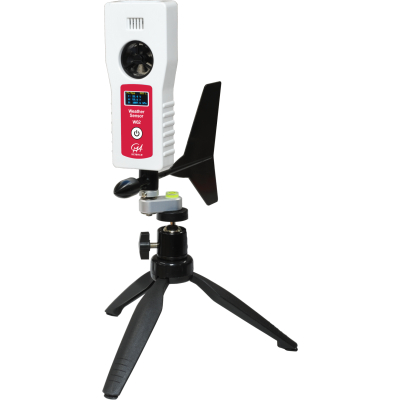
The wireless weather sensor can be used wirelessly via Bluetooth or wired via USB with the Coach 7 or Coach 7 lite programs/apps on computers (Windows and Mac), Chromebooks and mobile devices (Android and iOS).
Technical specifications:
- Measuring ranges: (resolution between brackets)
- Temperature: -40 .. 60 ℃ (0.1 ℃)
- Humidity: 0 .. 100 %RH (0.1 %RH)
- Barometer: 300 .. 1100 hPa (0.1 hPa)
- Wind direction: 0 .. 360 ° (±5 °)
- Anemometer: 0 .. 30 m/s (0.1 m/s)
- Light Intensity: 1 .. 188 000 lux (1 lux)
- UV Index: 0 .. 11 index (0.1)
- Warrantee: 24 months
- OLED display: 0.96” 128 x 64px
- Maximal sampling rate: 1 Hz
- Battery life: 8h when full (rechargeable)
- Connection: Bluetooth 5, Low Energy (Mac, Android, iOS) Bluetooth 2.1, Classic (Windows) or USB-C 2.0
All specifications of the sensor are described it its Product manual, see downloads.
Suggested geography and science experiments:
The weather sensor simultaneously measures primary parameters such as temperature, humidity, air pressure, wind speed and direction, light level, and UV index. Based on these basic measurements, many other weather parameters can be calculated or derived.
For environmental science, meteorology, and geography, this sensor can be used for various practicals that map the weather in different locations.
The following parameters can be derived from the primary values measured by the weather sensor:
- Dew point — shows when condensation or fog will form
- Absolute humidity — relates to “how much water is really in the air”
- Vapor pressure deficit (VPD) — connects to plant growth and evaporation
- Heat index — “feels like” temperature on hot days
- Wind chill — “feels like” temperature on cold, windy days
- Air density — links temperature, pressure, and wind energy
- Wind power density — lets students estimate potential wind turbine output
- Cloud base height (LCL) — a quick cloud formation predictor
- Beaufort scale — easy wind speed classification without much math
- UV exposure time — connects UV index to sun safety
- Irradiance from illuminance — shows sunlight as energy, not just brightness